What Students Learn
Lessons are tailored to each student’s age, goals, and learning style while building a strong technical and musical foundation. My teaching combines careful attention to physical ease, listening, creativity, and musical understanding so that students develop both skill and confidence on the violin.
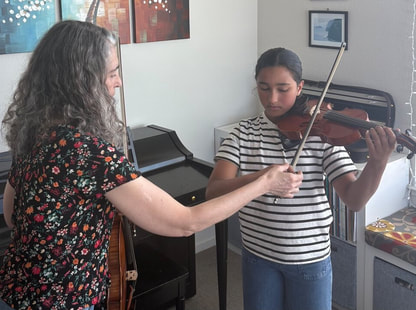
TechniqueStudents learn to play the violin in a way that works naturally with their body. We focus on balance, coordination, and releasing unnecessary tension while developing dexterity, control, and a resonant, beautiful sound. Students also learn how to listen carefully to the instrument and respond to physical and auditory feedback.
Ear TrainingA strong ear is essential for expressive and confident playing. Students develop pitch and rhythmic accuracy through singing, listening, movement, and playing by ear. They learn to recognize intervals, chords, and melodic patterns while strengthening their overall musicianship.
|
|
Practice Skills
Students learn creative and effective practice strategies that make practicing more productive and enjoyable. Lessons emphasize problem-solving, independence, and steady progress so students develop the tools to practice thoughtfully on their own.
Expression
Music is a form of communication and imagination. Students explore phrasing, tone color, character, and musical storytelling so they can develop their own expressive voice on the instrument
Music Theory
Students learn to read music fluently, understand scales and key signatures, and recognize harmonic patterns. Theory becomes a practical tool for learning repertoire, understanding musical structure, and supporting improvisation and composition.
Music history
Learning about composers, musical styles, and historical context deepens students’ connection to the music they play and enriches their understanding of the repertoire.
Improvisation & Composition
Improvisation and composition encourage creativity while strengthening listening, technique, theory, and confidence. Students are invited to explore music as something living, flexible, and personal.
Studio Offerings
Private Lessons
Lessons are offered weekly or twice weekly. The studio year runs from August through May, with summer lessons scheduled separately.
Beginning students generally start with 30-minute weekly lessons. By Suzuki Book 2 or the equivalent level, students typically transition to 45–60 minute lessons.
New students may schedule a 30-minute introductory lesson before deciding whether to enroll.
Beginning students generally start with 30-minute weekly lessons. By Suzuki Book 2 or the equivalent level, students typically transition to 45–60 minute lessons.
New students may schedule a 30-minute introductory lesson before deciding whether to enroll.
Group Workshops
Optional monthly group workshops supplement private lessons and provide opportunities to:
- perform for one another
- play in ensembles
- strengthen rhythm and ear training
- reinforce music theory through games and activities
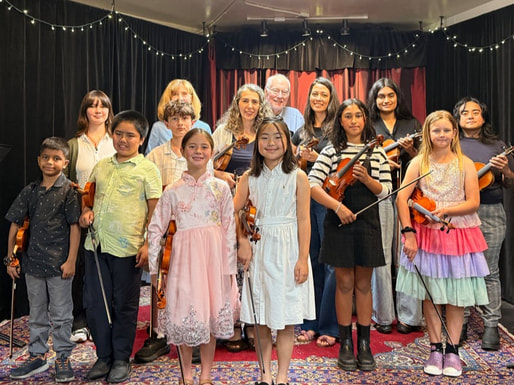
RecitalsThe studio holds two recitals each year, often organized around creative themes such as dances, animals, or music from around the world.
The spring recital includes ensemble performances in both small groups and full studio collaborations, giving students experience making music together. ASTACAP EvaluationsStudents may optionally participate in the ASTACAP Program each March through the American String Teachers Association. These evaluations provide clear goals, motivation, and valuable outside feedback.
|
|
Adult Students
Adult students of all levels are welcome, from complete beginners to returning players. Adult students are invited to participate fully in recitals and studio events alongside younger students.
Student Resources
Students receive personalized support materials to help them learn more effectively between lessons.
Custom Arrangements
Students may request simplified or level-appropriate arrangements of favorite pieces, including movie themes or popular songs. These are adapted to support healthy technique while matching the student’s current level.
Practice Materials
Customized practice resources may include short instructional videos, audio tracks, and targeted exercises designed to clarify weekly assignments and support efficient home practice.
Online Lessons
Online lessons are available when needed due to distance, travel, or scheduling conflicts. These follow the same structure and expectations as in-person lessons.
Studio Policies
Parent Participation
Parents or another supportive adult are encouraged to attend lessons, especially for younger students. Family support plays an important role in establishing productive practice routines at home, and I work closely with families throughout the learning process.
Practicing
Students are expected to establish a consistent home practice routine. During lessons, I help each student develop an individualized practice plan to support steady progress and effective practice habits.
Students should aim to practice 5–6 days per week. Questions between lessons are always welcome
Students should aim to practice 5–6 days per week. Questions between lessons are always welcome
Tuition & Payment
Tuition is based on 33 lessons during the academic year and is divided into equal monthly installments to reserve each student’s weekly lesson time.
Additional Fees:
- 30-minute lesson — $165/month
- 45-minute lesson — $247.50/month
- 60-minute lesson — $330/month
Additional Fees:
- Workshops — $135 series / $20 drop-in
- Recitals — $70 per year
- ASTACAP — $50-80 plus accompanist
Cancellation Policy
If you need to miss or reschedule a lesson, please provide as much notice as possible.
Lessons canceled with less than 24 hours’ notice, as well as no-shows, are charged in full. Same-day cancellations due to illness may be eligible for a makeup lesson within the school year when scheduling permits.
Lessons canceled with less than 24 hours’ notice, as well as no-shows, are charged in full. Same-day cancellations due to illness may be eligible for a makeup lesson within the school year when scheduling permits.
Required Materials
Students should have:
- a violin in good playing condition
- rosin and a cleaning cloth
- a music stand
- a 3-ring binder (at least 2" wide)
- a tote bag for music and accessories
- a tuner and metronome app on a phone or tablet
- for students 5 and under: a thin yoga mat for making a foot chart
Testimonials
My 6 year old niece has been taking violin lessons with Merav Singer for about 4 months now and she is absolutely loving it!! Merav is an inspiring, patient and kind teacher who is able to impart musical skills and concepts in a student-centered, friendly way. She motivates children to continue to learn and grow as musicians. My niece's increased self-confidence and love for the violin are proof.
- Anne M.
- Anne M.
Merav is a versatile music instructor. My 13 year old son looks forward to his violin lessons and is inspired to practice and improve. His words: "She gives practical instruction that can be applied to any song. She's helped me improve my posture, technique, and shifting. She is meticulous in a good way and chooses music that challenges me." We highly recommend her.
- Cristina R.
- Cristina R.
I have been taking lessons for over 2 years as an adult learner and have made a lot of progress! In the summer, I attended her small group lessons with young and older children. I felt as if we all had fun. Her exceptional knowledge of violin methods, positive outlook and creativity make each lesson worthwhile.
- Lisa W.
- Lisa W.
Merav is a great teacher! She is really patient and responsible. She always takes the time to correct my bow hold and teaches me ways to improve my intonation. She is also very encouraging, which is invaluable for an adult beginner like me. Most importantly, Merav is such a spirited and passionate musician! Her eyes literally light up when talking about music expression! She for sure instilled a passion for violin in me.
- Siqi L.
- Siqi L.
I'm a high school student who has spent 17 years unable to hear pitch, and more than a little off beat. Merav is a wonderful patient teacher with lots of different tools to get me from do to la. The first time I sung a song to my mama on pitch she was so happy for me.
- Imani H.
- Imani H.